 Robert Ambrogi Blog


Two years ago, the law practice management company Smokeball gave me an exclusive preview of its plans for an AI ecosystem spanning the full client lifecycle, anchored by an AI matter assistant called Archie, which it formally launched in July 2024.
Now the company has released the next generation of Archie AI, a major overhaul that moves Archie from a one-shot RAG approach to agentic, multi-step reasoning; makes it more accessible by embedding it directly into matters, Microsoft Word and Outlook; gives it access to more of their Smokeball data; and adds purpose-built apps for workflows such as chronologies, audio transcription and bank-statement analysis.
In a recent demonstration for me, Smokeball founder and CEO Hunter Steele walked through the new release and shared usage data on how the product has fared since its 2024 launch, including what he described as exponential growth in usage since the company shipped the first wave of these updates earlier this year.
“AI shouldn’t feel like a separate tool lawyers have to learn or adapt to; it should work the way they already do,” Steele said in the company’s announcement of this update. “With Archie: Next Generation, we’ve embedded powerful, agentic AI directly into the core of legal workflows, so firms can move faster, work more accurately, and stay focused on what matters most.”
Smokeball, founded in 2012 and with offices in Chicago, Sydney and London, sells cloud-based practice management software to small and mid-sized law firms in the United States, Australia and the United Kingdom. Most of its customer base is firms of two to 30 people.
Two Years of Usage Data
Before demonstrating the product, Steele shared numbers on Archie’s adoption over its first two years — data the company used to guide development of its next-gen product.
When Smokeball first began talking about AI two years ago, he said, ABA survey data put AI use among lawyers in its market at roughly 20% to 30%, counting even those who had merely signed up for free ChatGPT accounts.
Smokeball’s survey of its own clients at the end of 2025 found 81% using AI, a figure Steele believes is even higher today.
Over those two years, Steele said, users have typed more than 2.5 million prompts into Archie, and the product now has more than 20,000 daily users.
Steele also shared data on what those users are doing with the tool. About 49% of prompts involve finding, reviewing or summarizing information within a matter – what he described as “needle in the haystack type stuff.” A nearly equal share involves drafting or redrafting documents, emails and memos. Only a small fraction involves legal research questions.
“What we’re kind of finding in our small space is that they’re loving using AI to just get more work done and be more efficient,” Steele said. “When it comes to legal research, they’re OK – probably scared is probably the word I would use, but also happy enough doing what they’re doing because they see so much value everywhere else.”
Steele said the most common first prompt a new user types is simply “summarize this matter.” That observation drove the company to build a prompt library, where users can save their own prompts, share them within their firm, or use prompts Smokeball publishes.
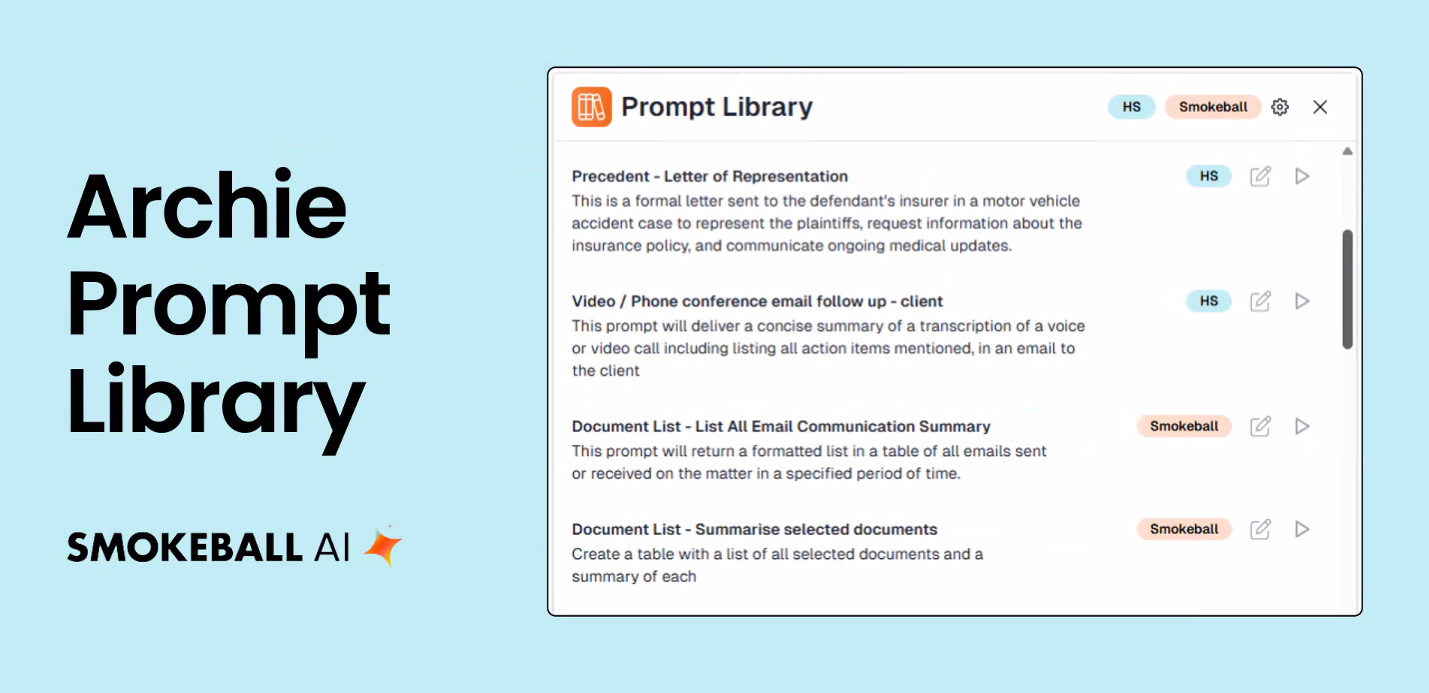
About 40% of all prompts now come from saved templates rather than being typed ad hoc, he said. An “improve prompt” button, which uses AI to restructure a user’s prompt into a more detailed one, is now used on roughly 20% of prompts.
Steele said Smokeball is also evolving prompts into more structured templates that can ask for inputs, run a sequence of prompts, and produce more consistent outputs – an approach he compared to bringing document-automation concepts such as fields, values and logic into prompt design.
After Smokeball released the first wave of its next-generation updates in late February and early March this year, usage took off, Steele said. Since January 2026, prompt volume has grown over 241%, is now 10.4 times what it was at launch, and is growing 28% month over month.
“There isn’t one single one that was the golden arrow,” Steele said of the changes driving the growth. “I think it’s a mix of all of them – putting it where they want to be, making the models and the agents better, and then introducing it into Word and Outlook.”
From RAG to Agentic Reasoning
At the core of the new release is what Smokeball describes as a foundational shift from a one-shot retrieval-augmented generation (RAG) approach to an agentic architecture, in which Archie reasons through a request in multiple steps, retrieves deeper matter context, reassesses its work, and shows the user the steps it took.
“Early days, [we were] using one-shot RAG, which is basically what was great about AI a year ago and not so great today,” Steele said. “The problem with that is, as we know, lawyers don’t normally work one step at a time.”
Alongside the new architecture, Smokeball expanded the data Archie can access. Where the assistant originally worked from client details and ingested documents, it now has access to every piece of data for a matter that the system contains – tasks, calendar events, billing, trust balances, outstanding invoices, memos and file notes.
The agent can also take actions such as creating tasks, memos and calendar events, with user approval.
Users can choose which underlying large language model powers Archie, with options including OpenAI’s ChatGPT, Anthropic’s Claude and Google’s Gemini. The current default is GPT-5.2, Steele said, though the company runs evaluations across models and would change the default if another proved substantially better. He noted that a growing number of users are opting to switch to Claude models.
In the demonstration, using a mock divorce matter, Steele asked Archie what a marital settlement agreement said about closing joint accounts and whether the opposing party had complied. The agent broke the request into steps – searching the matter’s documents, reading the settlement agreement, reviewing correspondence – and returned an answer citing the relevant MSA provision and the emails showing noncompliance, with its reasoning steps visible to the user.
In an estate-planning matter, Steele showed how Archie could easily compare a couple’s estate plans side by side and identify differences in successor designations across all documents. Steele said the prior RAG-based approach would likely have struggled with that task because it required gathering and comparing multiple documents step by step.
Embedded in Word, Outlook and the Matter
A central theme of the release is putting Archie where lawyers already work rather than in a separate tab.
“They’re kind of like, we need it more,” Steele said of user feedback. “Every time we draft an email, we want it to be there. Every time we’re in Word, we want Archie to be there.”
This new version aims to accomplish that in three ways:
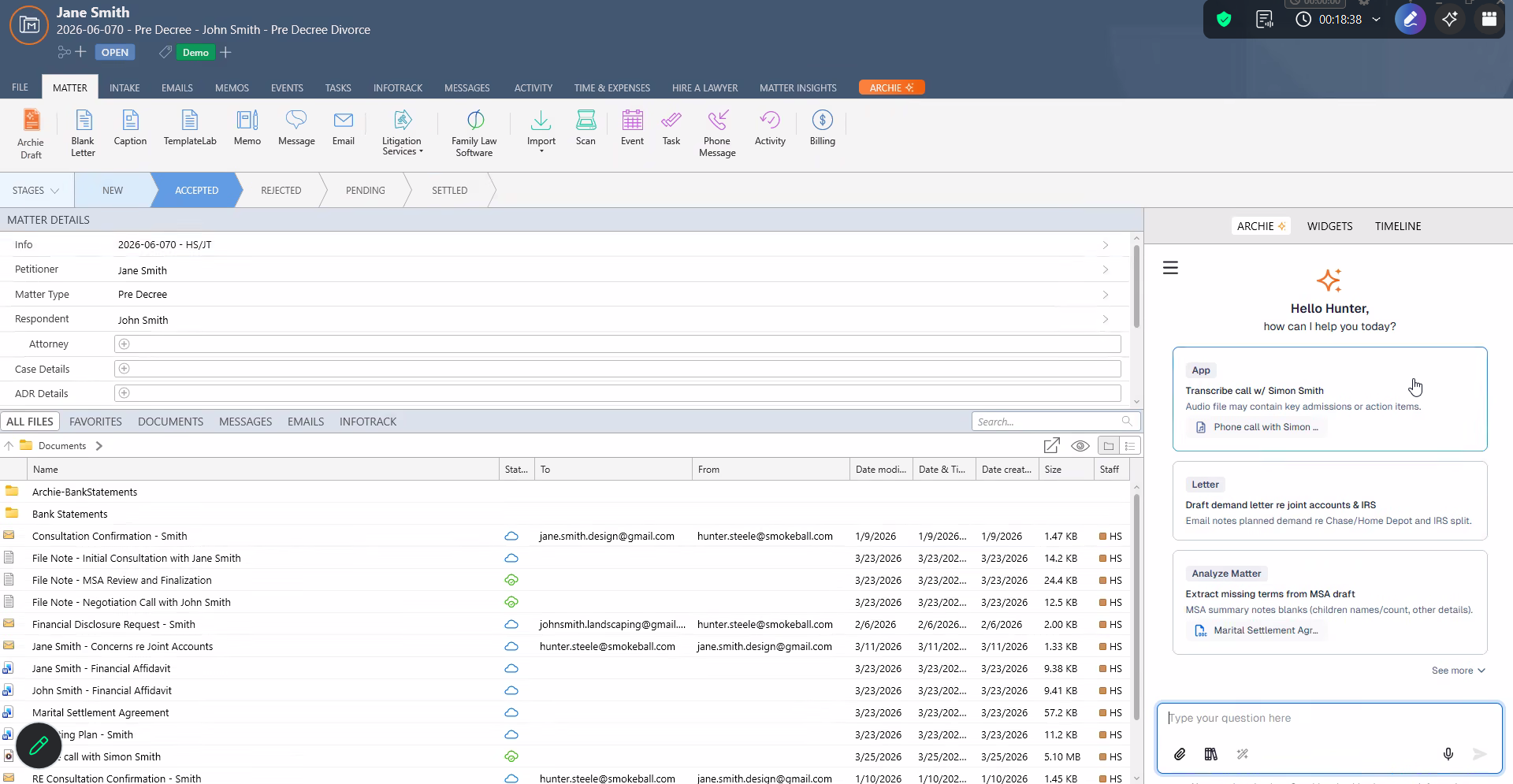
The matter widget proactively analyzes matters and surfaces actionable next steps.
Archie Matter Widget. Archie now appears as a widget on each matter’s home page. Rather than presenting a blank prompt box, the widget analyzes the matter’s recent documents, emails, tasks and calendar events and proactively identifies suggested actions as clickable tiles. These might include, for example, transcribing a phone call saved to the matter, drafting a follow-up email to a client about an outstanding financial disclosure, or analyzing a draft agreement for missing terms. In the demo, the suggestions were specific to the matter’s actual contents, referencing files and correspondence by name. Clicking a tile writes and executes the prompt automatically.
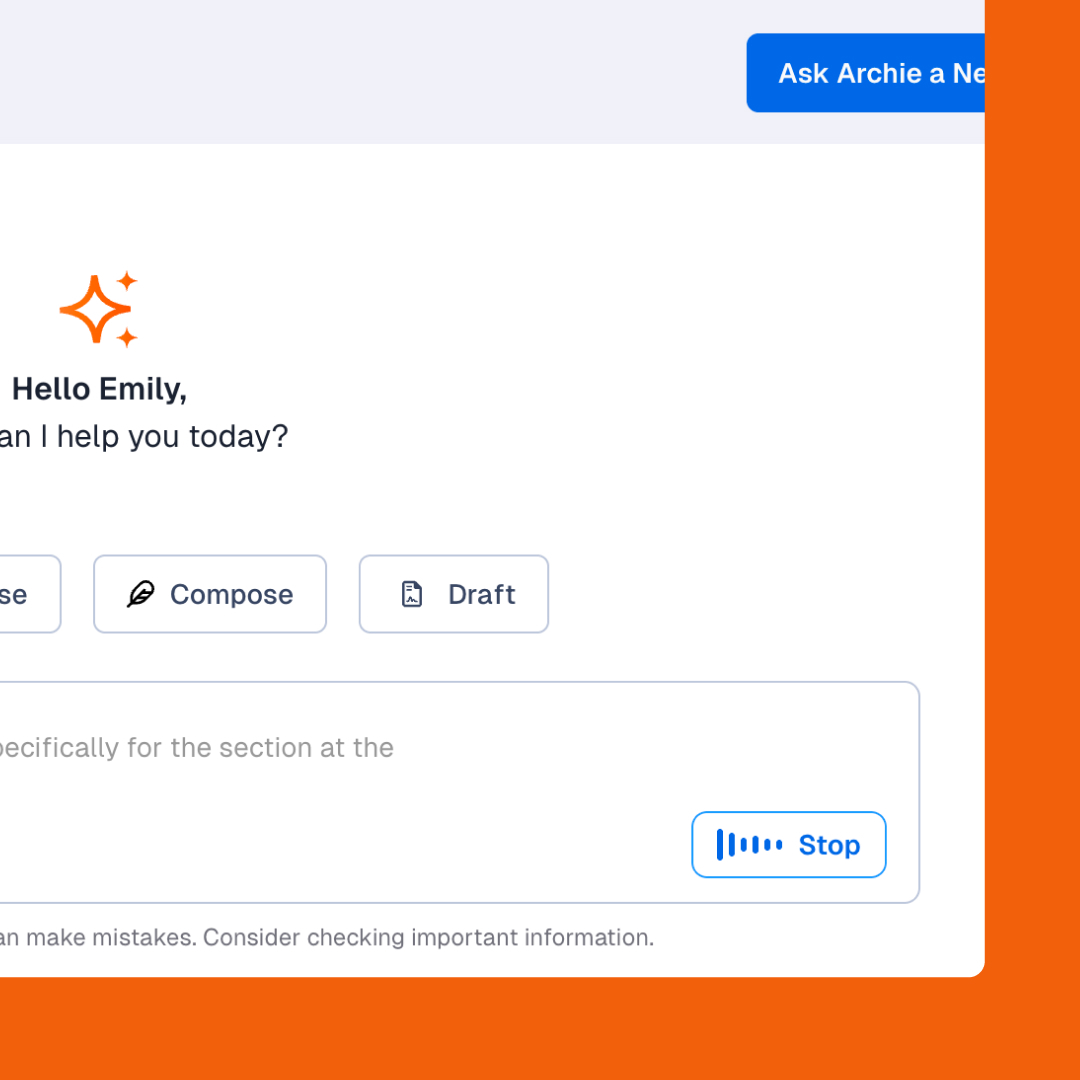
Lawyers can use Archie directly within Word to draft, edit and analyze documents.
Archie for Word. A new Word add-in gives Archie its own toolbar inside Microsoft Word, alongside Smokeball’s longstanding document automation toolbar. The add-in automatically knows which matter a document belongs to and offers suggestions specific to that document. In the demo, working in a pour-over will, Steele asked who would care for the client’s children if the client died. Archie answered and, on request, navigated directly to the guardianship provision in the document. When Steele told Archie the client wanted to substitute a different guardian, the assistant located the provision and made the change as a redline using Word’s native track changes, which the user can then accept or reject.
The Word add-in also supports structured document reviews using playbooks, flagging issues as passing, failing or warranting a warning. In the demo, an 11-rule pour-over will playbook flagged concerns with the document’s execution attestation and self-proving affidavit sections. Playbook-style review has been a focus of AI tools aimed at large-firm contract work, Steele acknowledged, but Smokeball is building playbooks down to the practice-area level for its small-firm market, where he said estate planning has emerged as an early use case. The Word add-in additionally includes access to the prompt library and an initial app for translating selected text.
Archie in Outlook. An Outlook add-in brings Archie into the email workflow, with thread summarization, drafting and refinement with matter context, and AI-suggested replies. Throughout the demo, drafts generated in Archie could be sent to Outlook with one click, pre-addressed and with a subject line, or to Word as a letter on the firm’s letterhead with the subject line populated by Smokeball’s existing document automation.
Archie Apps: Beyond Chat
One of the more surprising lessons of Archie’s first two years, Steele said, was how far beyond simple drafting and summarization users tried to push it. They would ask it, for example, to summarize 43 sets of medical records, analyze spending across 15 bank statements, or build full chronologies.
“Archie wasn’t necessarily built for that, to be honest,” he said, and results were mixed.
The company responded with Archie Apps, tools built for specific tasks, with their own interfaces, that live within the Archie workflow. Steele featured two of these in the demo:
- Transcription. Archie can transcribe audio and video files saved to a matter, including phone calls captured through integrated phone systems such as VXT or Zoom recordings, and present the result in an interactive interface with speaker identification, a summary, key discussion points, and decisions and outcomes. Clicking any item jumps to that point in the recording and plays the audio. Users can chat with the transcript, draft an email based on it, or save it to the matter as a Word document. So far, transcription has been the most heavily used of the apps, Steele said.
- Bank statement analyzer. Aimed particularly at family law, the app extracts every transaction from uploaded PDF bank statements into a sortable, filterable table. In the demo, it extracted about 1,500 transactions from a set of bank-statement PDFs, a process that Steele said typically takes about a minute to run. Users can filter by debits, sort by amount, click any transaction to view its source location in the original statement, and apply AI-generated indicators, such as flagging all transactions that appear alcohol-related. An AI-powered search goes beyond simple keyword matching. Steele conducted a search for transactions related to “our holiday in Fiji” and surfaced charges in Fijian dollars and cruise bookings that never mentioned Fiji by name.
The company has also built a chronology app, and Steele said more apps are in development.
Voice, Tone and Legal Research
The release adds voice dictation, allowing users to speak prompts rather than type them, and tone profiles, which let firms adjust how emails, letters and memos should sound for different audiences.
Steele said Smokeball is also working on more granular tone controls – by practice area, staff member and client – and experimenting with learning tone from a lawyer’s prior emails to a particular client.
One area Smokeball does not intend to build itself is legal research, Steele said. For that, Archie routes legal questions to integration partners. The first such partner is LawY, an AI legal research tool that is part of Smokeball’s group of companies and offers optional human verification of AI answers by qualified lawyers.
In the demo, when Steele asked what his options were under Florida law to enforce the MSA, Archie recognized the question as a legal one, sent it to LawY, and then fed LawY’s answer back through its own agent to apply the law to the facts of the matter. It also offered, as a next step, to draft a demand letter based on the research.
Still in development is Smokeball’s integration with Thomson Reuters, which I reported in March. That will connect Archie with TR’s CoCounsel Legal and will work the same way as with LawY. Users with a TR subscription will be able to ask a legal question in Archie, get the answer from TR’s platform, and have Archie apply it to the matter.
He said the companies have been working on the partnership for about eight months and that he hopes the integration will ship within the next couple of months.
This will offer users a layered approach to legal AI, Steele said. “Archie helps you get the work done. LawY is great for that practical legal question where you want a quick answer. And if you want to do full legal research, TR is the best in the market.”
Steele emphasized that Archie does not send personally identifiable matter data to LawY or, once integrated, Thomson Reuters. Instead, Archie routes the legal question, receives the research response, and then applies that answer back to the facts of the matter inside Smokeball’s own agentic workflow.
What’s Coming Next
Steele also previewed features on the roadmap for roughly the next six months:
- Firm-level Archie. Currently, Archie operates within a single matter and cannot answer questions across matters, such as which 10 clients owe the firm the most money. Steele showed me an unreleased version, now in internal testing, that adds Archie at the Smokeball home-screen level with access to billing and finance data across the firm, along with cross-matter document search. It is targeted for release in about three months, he said.
- Skills. Beyond prompts, users will be able to run “skills,” which Steele described as more advanced, multi-step instructions the agent can execute. Eventually, users will also be able to create and share skills.
- MCP integrations. Smokeball is opening its agents to Model Context Protocol endpoints, starting with its sister company InfoTrack, whose services include court e-filing. This could enable, for example, Archie to draft a document and then file it with a local court.
- Mobile. Archie is coming to Smokeball’s mobile app, expected within the next month or so, with the same matter widget interface.
- Draft by example and AI form filling. Users will be able to point Archie at template documents or documents from previous similar matters and have it draft new documents in that style, and AI will pre-populate Smokeball’s library of automated forms.
- A prompt and skill community. Beyond Smokeball-published and firm-shared prompts, the company plans to let users share prompts and skills across firms, organized by practice area and jurisdiction.
Steele said the goal across all of it is for AI to become “a normal piece of functionality when lawyers are interacting with Smokeball in their day, rather than a separate tool that they go and use.”