 Robert Ambrogi Blog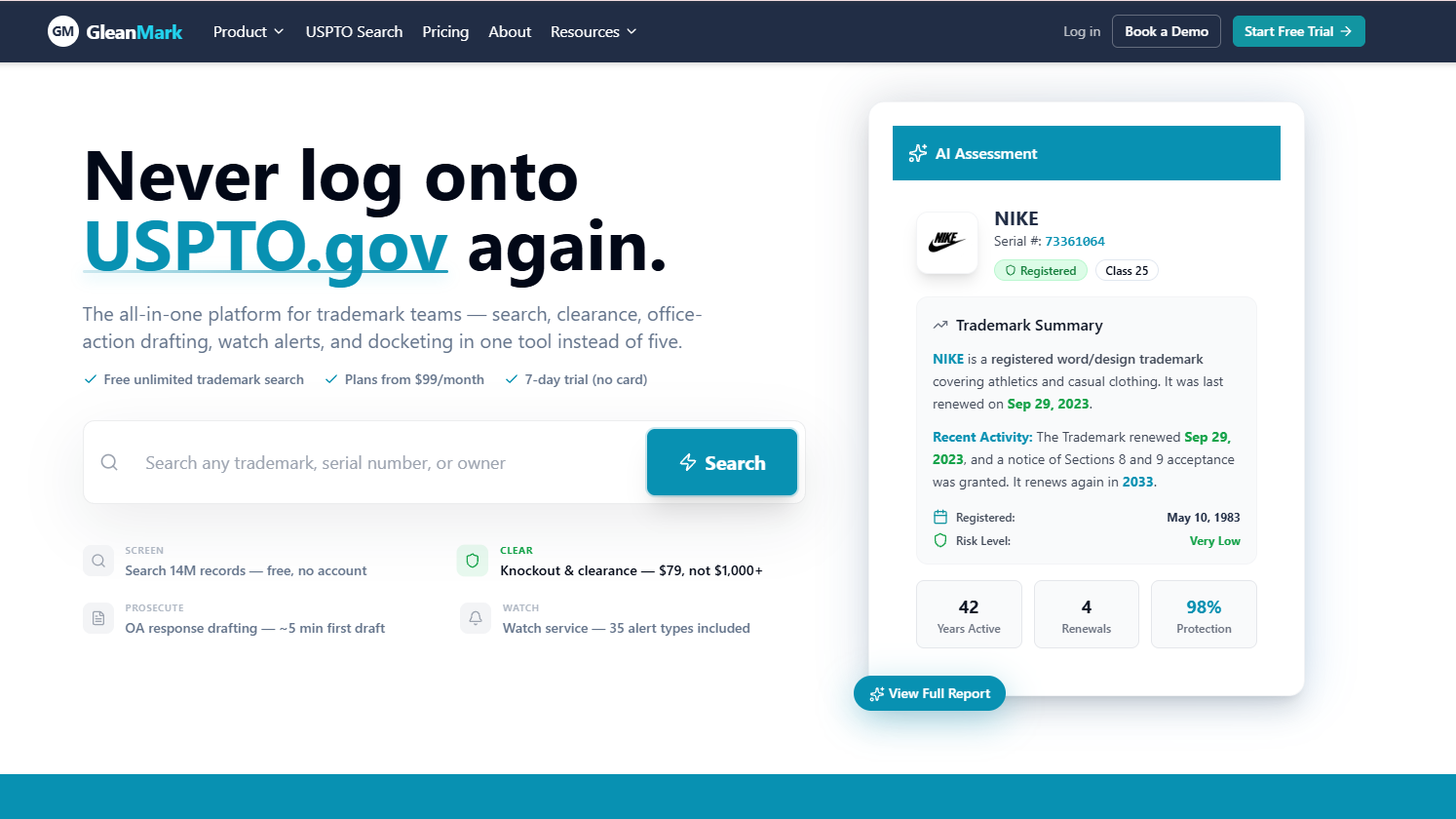


Howard Katzenberg’s idea for a trademark software company began with a trademark fight of his own. Today, he is formally launching that software, called GleanMark, a U.S. trademark research and workflow platform for lawyers.
The platform combines free USPTO search with AI-driven clearance analysis, office-action response drafting, automated deadline tracking, and portfolio monitoring, all built on the company’s own structured copy of the entire federal trademark register.
It is already in use by a number of law firms to manage multi-thousand-mark portfolios, Katzenberg said.
Together with the launch, GleanMark is releasing its inaugural State of Trademark Filings report, an analysis of all 408,346 U.S. trademark applications filed from January through July of this year.
The report finds, among other things, that roughly one in every 20 new applications now claims artificial intelligence in their goods and services, nearly triple the number of two years ago.
A Trademark Fight Inspires A Trademark Tool
Katzenberg spent 11 years as a fintech CFO before founding Glean AI, an accounts-payable automation startup, in 2019. After he started it, a much larger company, Glean Technologies, began building its brand with the same name. It had no trademark registrations, while his company held three.
“They bought the dotcom and they just took complete ownership of that name,” he told me, “and it affected our ability to use Google, to do search engine optimization, to do paid search, and really grow.”
As he became embroiled in that fight, he turned to the USPTO’s public trademark tools. He was impressed with the richness of the agency’s database but frustrated with how cumbersome it was to use. It had no way to compare marks side by side, no alerts when a mark’s status changed, and search that seemed to have been built decades ago.
So, after selling Glean AI in April 2025, he decided to build the tool he had wished he had as a brand owner.
A Platform for Practitioners
I first spoke to Katzenberg in February, when he showed me an early, pre-release version of the product. At that point, he was still thinking about it from the perspective of brand owners. But as he spoke to trademark attorneys and heard about their pain points in searching and tracking trademarks, he altered his roadmap to focus on them.
Their pain points centered on two workflows. One was the process of clearing a proposed mark before filing. The other was responding to office actions – the examiner refusals and requirements that, according to GleanMark’s own data, have impacted more than 233,000 applications just so far this year.
So, Katzenberg followed their lead and centered the product around those two tasks.
A Demo of the Clearance Search
GleanMark’s clearance tool takes a proposed mark and goods-and-services description and returns, within about a minute, a risk-ranked analysis of potential likelihood-of-confusion conflicts under Section 2(d) of the Lanham Act, drawing on both the register and the live web.
Rather than a bare similarity score, it shows why each conflict surfaced – such as exact match, phonetic similarity, shared dominant element, foreign-language equivalent. It also shows the conflicting mark’s own prosecution history, including whether examiners have cited it against other applicants and how those applications fared.
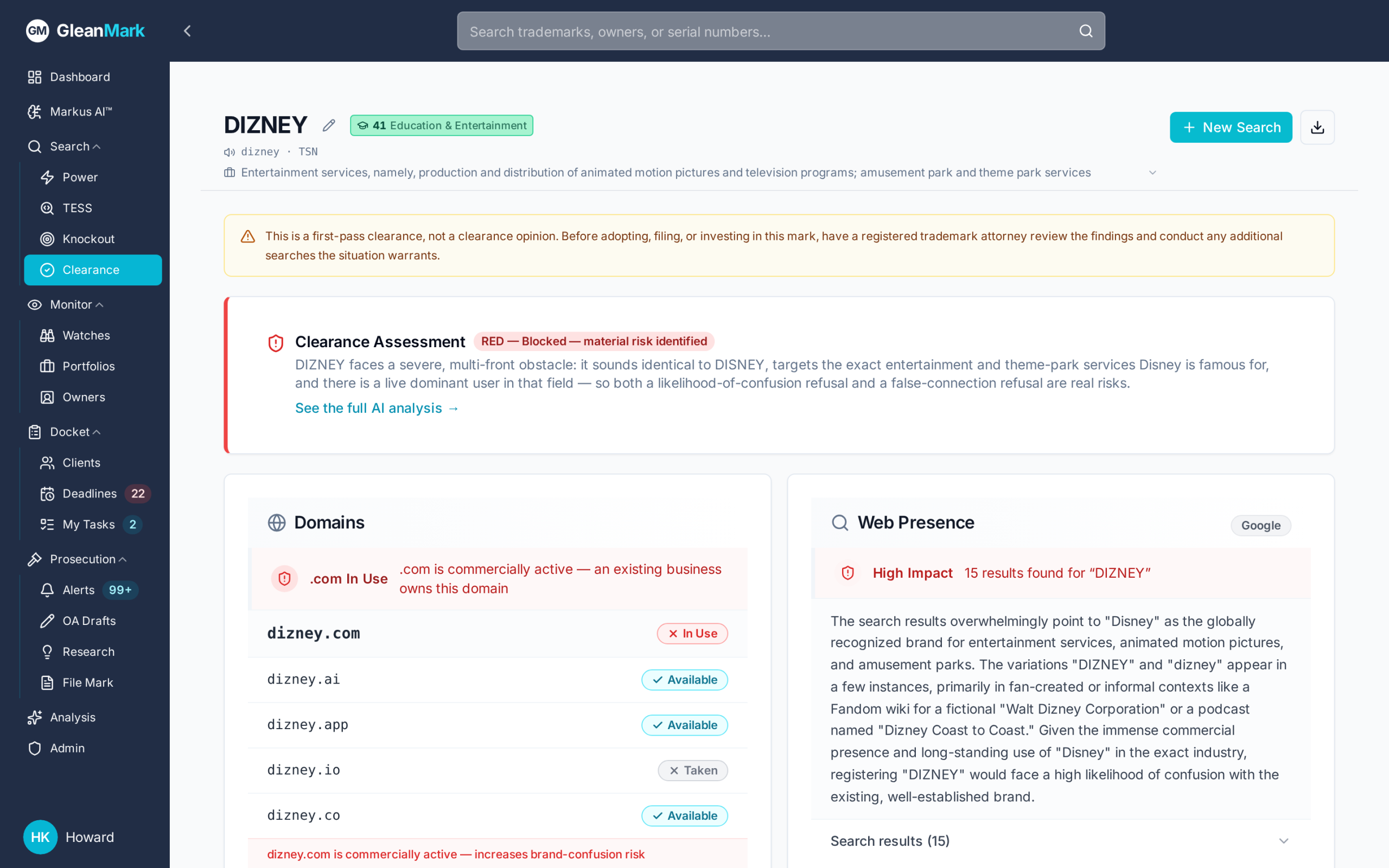
A clearance assessment in GleanMark. The company notes that it starts with the reasoning, not just a score, alongside domain availability and live web presence for the same name.
In a demo on Friday, Katzenberg pulled up a pending application for the mark POLISHED, for nail salon services. It had drawn a Section 2(d) refusal from a USPTO examiner two weeks earlier, citing five registrations owned by a single Texas company.
He ran the same mark and description through GleanMark’s clearance tool. Its five highest-risk hits were the same five registrations the examiner cited.
Katzenberg compares his platform to the legacy route of using clearance vendors, where a commissioned search can cost hundreds of dollars, take days to come back, and arrive as a doorstop-sized PDF.
“Something that used to take maybe a day or two to get back from another vendor and then put your own opinion on it now could really take an hour,” he said.
Drafting Office Action Responses
GleanMark’s second core tool drafts responses to office actions, with an emphasis on Section 2(d) refusals. It develops the same types of arguments trademark lawyers would make themselves, Katzenberg says, and also assembles the supporting exhibits behind each argument.
“Unlike tools that generate fluent argument and stop there,” the company says, “GleanMark backs its arguments with material pulled from the prosecution record — real third-party registrations, crowded-field evidence, coexistence examples, and prosecution events the attorney can verify, not citations a model invented.”
Given the profession’s concerns around AI hallucinations, I asked Katzenberg how the tool verifies results. Every cited registration, he said, is validated in a second pass against GleanMark’s own database before it appears in a draft.
The product includes what the company calls “an honesty gate.” “It withholds an argument the record cannot support, and it flags when supporting evidence is thin rather than asserting a crowded field or coexistence that does not hold up.”
He emphasized that this is not a replacement for the lawyer. “This is a first draft. Someone definitely needs to review this.”
Markus for AI Chat
Another feature of GleanMark is Markus AI, a chat-based research assistant. Its uses can include searching its collection of USPTO records, comparing firms, and analyzing TTAB proceedings.
Unlike general purpose AI models, every answer Markus provides is based on the USPTO record and carries serial and proceeding numbers that the user can verify against that record.
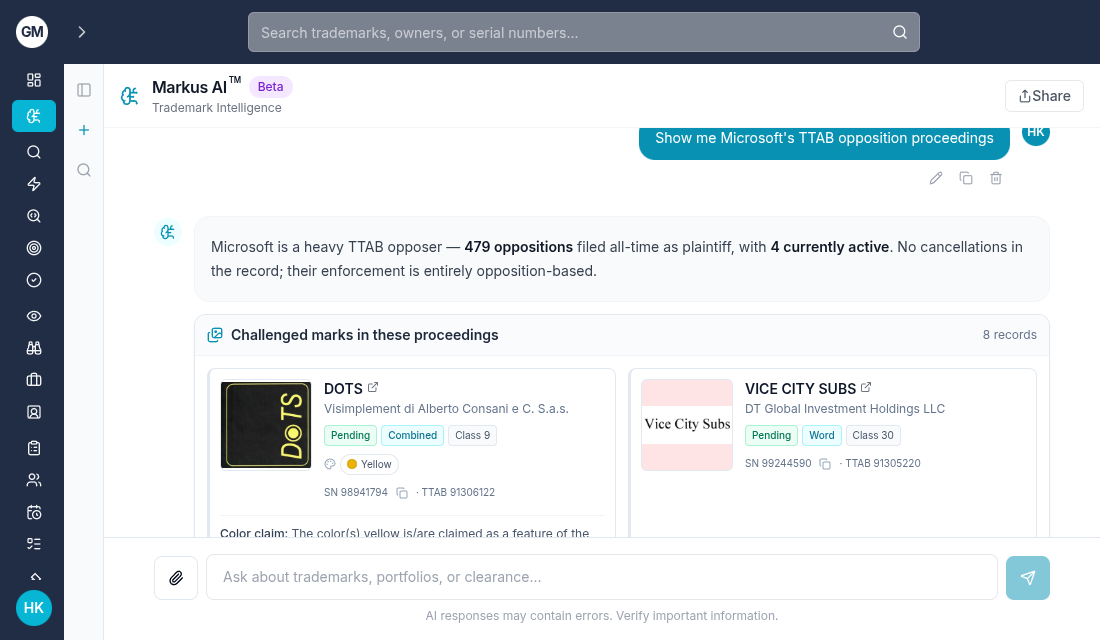
Markus answers plain-English questions against the live register.
The platform requires no set-up. Attorneys sign up with their email address, and GleanMark matches it against the USPTO correspondent record to populate their clients, marks and deadlines automatically.
The platform automatically generates deadlines for office action responses, statements of use and renewals and clears them automatically as the record updates.
It also includes semantic watch alerts, a design search, firm-branded monthly client reports, and a $99-a-month lead-generation add-on that identifies office actions in which examiners recommend the applicant retain counsel.
Pricing and Target Market
For basic USPTO search, GleanMark is free, with no account required, and free accounts can monitor a single mark or owner.
Paid plans start at $99 a month for brand owners. Law firm plans start at $250 a month for smaller firms and $700 a month for an unlimited plan that includes five clearance reports a month, with additional reports at $79 each. A day pass is available for low-volume solo practitioners.
Katzenberg says he is not targeting the enterprise market served by incumbents such as Corsearch and Clarivate, which he says are priced and designed for the largest firms and brands, sometimes at $20,000 a year or more.
His target is the large number of smaller trademark practices, firms with portfolios in the hundreds to low thousands of marks.
He is also adamant that he has no plans to expand into patents or to become a full docketing replacement. “We are 100 percent focused on just trademarks,” he said. “We want to be the best in the world at the USPTO and understanding it.”
GleanMark’s Research Findings
With regard to The State of Trademark Filings report that accompanied GleanMark’s release, Katzenberg says the company will publish it every six months.
The report draws from the same corpus that powers the product – some 14 million USPTO records and more than 240 million prosecution events – and compares the first seven months of 2026 against the same period in prior years.
Among its notable findings:
- An “AI land grab.” Applications whose goods-and-services descriptions include the phrase “artificial intelligence” grew from 1.76% of all filings two years ago to 4.87% this year – a total of 19,867 applications.
- Companies are naming AI products before launching them. Of this year’s AI-claiming applications, 65.4% were filed on an intent-to-use basis, meaning before they were put into commerce, compared to 48.2% for everything else.
- The filers are not who you might expect. LLCs and individuals account for nearly half of AI applications, while Google ties for 11th among the most active AI filers.
- The USPTO is digging out of its backlog. The median wait from filing to a first office action fell from 251 days two years ago to 133 days this year, and the median time from filing to registration fell from 407 days to 286. For practitioners, that means that refusals, conflicts and deadlines now arrive roughly twice as fast as they did two years ago.
Some other trademark trivia from the report:
- “AI” is now the second-most-disclaimed term in new applications, behind only “CO,” with applicants formally renouncing exclusive rights to it 695 times so far this year.
- The registrations that blocked the most different applicants under Section 2(d) this year belong not to tech giants but to a Mexican tequila council for TEQUILA, a 1974 registration on PICKLE-BALL, and the National Association of Realtors registration of REALTORS.
- Epic Games registered the word AGENTIC in 2023. That year, only two applications used the term. This year, it has been used in 513 applications so far, with the USPTO already having refused nine because of Epic’s registration.
“Trademark filings are intent, filed in public,” the report says, “and right now America’s intent is AI, filed by newcomers, and arriving at an Office clearing the queue faster than at any point in the three years we can measure.”
The full report is at gleanmark.com/reports/state-of-trademark-filings-jan-jul-2026, and the company’s launch announcement, with fuller product detail, is at gleanmark.com/press/gleanmark-launch.