 Robert Ambrogi Blog


It certainly has been no secret that Thomson Reuters has been building its own proprietary large language model. In fact, in my June interview with TR’s CEO Steve Hasker, he talked openly about it, and just a few weeks ago, I reported on TR’s release of preliminary benchmarking data that showed impressive results comparable to the best general-purpose AI models.
But today TR makes it official, launching Thomson, an LLM that TR emphasizes was developed at a fraction of the cost of the frontier LLMs such as ChatGPT and Claude and that TR fully owns and controls.
More importantly – at least when it comes to positioning within the legal market – TR highlights the fact that Thomson was trained and built using its own proprietary content built up over decades, as well as its own technology and, as it says, “domain expertise no other company can match.”
Joel Hron, TR’s chief technology officer, says this is an achievement that could change the economics of professional AI.
“For years, the AI industry has treated scale as the answer: bigger models, more compute, more money,” he says. “Thomson shows there is another path.
“Start with a strong foundation, specialize it deeply for the work that matters, and you can build intelligence that is highly capable, far more efficient and entirely under your control.”
Compared to the billions spent to develop models such as ChatGPT and Claude, TR says it has invested some $40 million into developing Thomson over the past two years, covering both talent and compute. And during a media briefing last week, Hron revealed that the final training run for the version launching today cost just $450,000.
“This $450,000 number I think is indicative of what we were able to do with our data and content on top of world-class open source models,” Hron said.
To Be Deployed in CoCounsel
Thomson will get its first deployment in an upcoming release of CoCounsel Legal, driving its Tabular Analysis functionality. TR says this is “exactly the kind of high-volume, structured document review where a purpose-built model’s advantage shows up immediately.”
Thomson will be the default model for Tabular Analysis, Hron said, although administrators will be able to switch the feature to another model through CoCounsel Legal’s admin settings.
Overall, CoCounsel will remain multi-model, tapping into whichever LLM is best suited for the task at hand. TR says it will apply Thomson “where it delivers the clearest advantage” and other models elsewhere.
Over time, Hron said, he expects Thomson to take “a bigger and bigger share of the tokens” and of the work CoCounsel is doing, and the company says it plans eventually to extend Thomson models across its portfolio of legal and tax products.
“Thomson does not need to keep pace with the frontier of general intelligence across all dimensions,” he said. “Thomson needs to set the frontier of intelligence for legal.”
Beyond its own products, TR has begun early conversations with large law firms and corporations about direct access to the model, Hron said, including firms interested in fine-tuning it with their own data as they look to bring greater sovereignty to their own knowledge and expertise.
“We are very open to working with those organizations and to Thomson being licensed directly,” Hron said in a Q&A document TR provided to media, adding: “We built Thomson as infrastructure for Thomson Reuters. What we are beginning to see is that it could also become infrastructure for others.”
How Thomson Was Built
The model launching today is formally Thomson 1.0, the first in what Hron described as a family of models that will carry the Thomson name.
Rather than build a model from scratch, TR started with an existing open-source model and trained it to become a legal specialist. Although the models it used changed over the course of the project, the most recent was Qwen 3.5.
Jonathan Schwarz, TR’s head of foundational research, said during the media briefing that the process involved TR first aligning the model’s values and behavior with its own, and then continuing to train it exclusively on TR’s proprietary content from Westlaw, Practical Law, Checkpoint and Reuters. The final step was to train it to work directly with TR’s own research tools.
Central to that process were TR’s subject-matter experts – the armies of lawyers and tax professionals it employs. Andrew Bean, who heads TR’s evaluations team, said hundreds of experts helped decide what the model should be trained to do in the first place, created many thousands of examples of high-quality answers, and then judged the model’s outputs in blind, head-to-head comparisons against frontier models.
None of that training data comes from customers. “We do not use customer data at all in that process,” Hron said in response to a question about governance. Rather than mining customer data for training signals, TR replicates the relevant tasks with its own experts.
He also said TR has engaged several third-party security firms to validate the hosting, serving and security controls around the model.
Because open-source models keep improving, TR built the process to be repeatable. Hron said TR has swapped out its open-source starting point close to half a dozen times over the life of the project as better models have emerged.
“The bigger finding here is less the individual model and more the model factory we built,” Schwarz said.
The result, Schwarz said, is a model that gained deep capability in legal and tax work without losing the general abilities – writing, math, reasoning over long documents – that narrowly fine-tuned models often sacrifice.
Putting It To the Test
TR says its internal testing of Thomson has shown strong results.
One evaluation described during the briefing was an in-house benchmark TR calls Deep Research, built around legal research queries drafted by its experts based on the work they would do in practice. For each query, the experts also supplied the criteria a good answer should contain.
Answers were scored on two dimensions: completeness, meaning whether the answer contained all the elements of a right answer, and factuality, meaning whether the citations provided actually supported the claims being made.
“You can have a model that provides a correct answer,” Bean said, “but more importantly, you can have a model that provides a correct answer with proof that it is correct.”
Using that benchmark, TR compared Thomson against GPT 5.4 and Claude Sonnet 5, scoring each model twice – once with access only to web content and once with access to TR content.
You can see the results in the image below. While Thomson performed respectably in the web-only test – “within the scope of the other models, but certainly not the leader yet,” as Bean put it – it did much better in the test using TR content, outscoring both of the other LLMs.
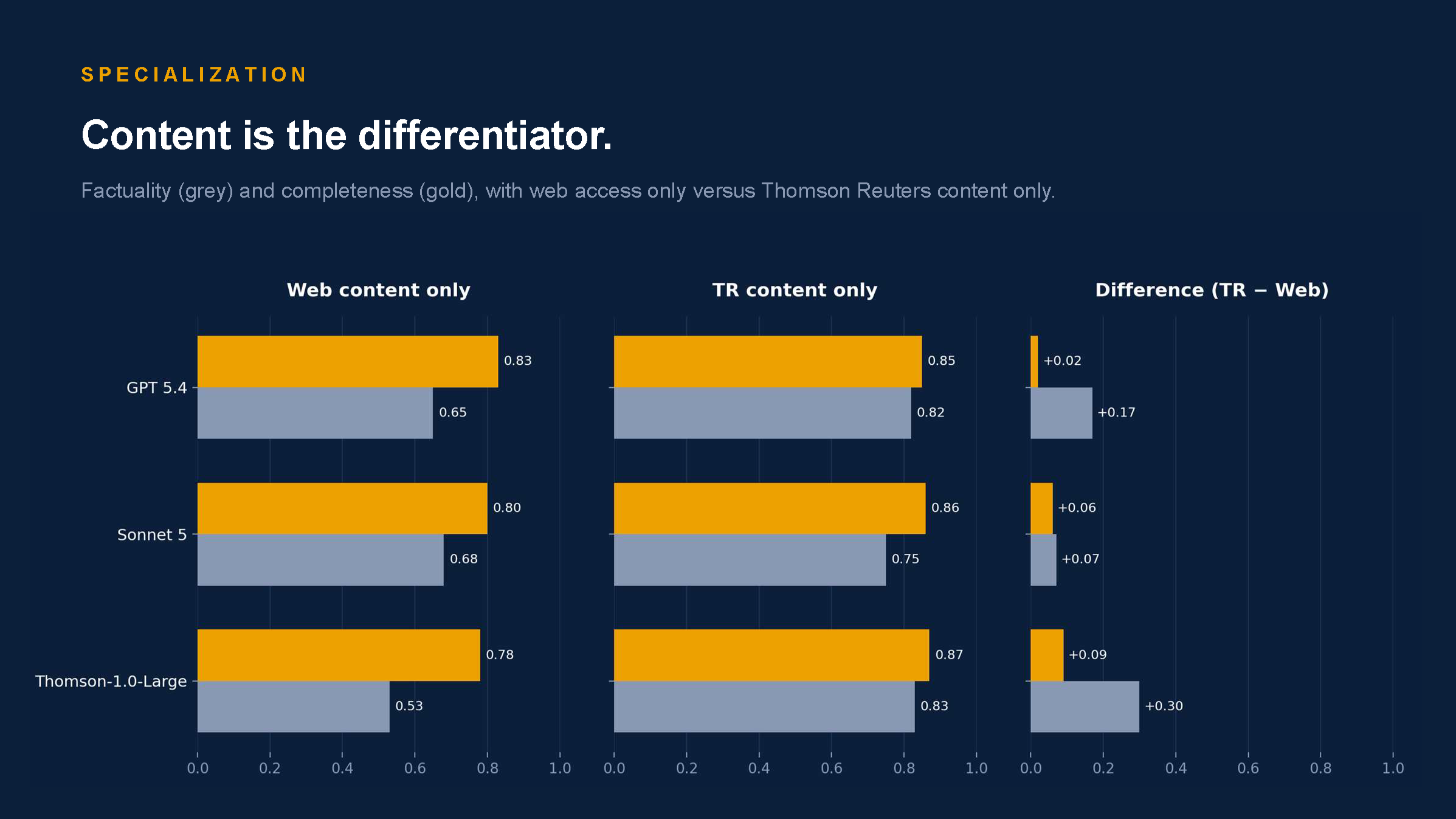
“The last column really shows that there’s a big uplift that comes from being able to train on and practice with your own tools,” Bean said. “And that’s the sort of specialization that we think is a real value of having our own in-house model.”
In response to my question during the briefing about whether TR would release more detailed benchmarking, Schwarz said TR will publish a technical report this week with a comprehensive set of evaluations, including results on standard public AI benchmarks, legal-specific benchmarks and human testing.
TR has also begun making the model available to a group of legal and AI academics for their direct evaluation, and it is making a “small” version available as an open-weight model on Hugging Face, under a non-commercial academic license, to broaden the evaluation.
Hron said TR sees the open-weight release “as a mechanism for really anybody in the world to pick it up and critique and validate or invalidate any aspects of what we’re saying.”
One of those academics, Jonathan H. Choi, at Washington University School of Law, in a statement provided by TR, said that he tested Thomson against ChatGPT and Claude using what he considered to be some of the more challenging questions students have asked in his Corporate Tax class.
“All three models answered the questions correctly, but I preferred Thomson’s responses overall. I especially appreciated the links to treatises, which made its responses more transparent and useful for legal work.”
TR is also building a developer portal that will eventually allow outside parties to access the model directly, with API keys, configurable parameters and sample documentation. Hron demonstrated an early version during the briefing, but cautioned that it is “still very early at the moment.”
Early Days
While emphasizing Thomson’s training on its “decades of authoritative content,” TR says the model has so far been trained on less than 10% of that content.
“What comes next is not simply feeding it more data,” the company says. “It is continued discovery of new kinds of specialization and understanding, made possible only by building on decades of proprietary content and editorial expertise.”
In its announcement of the launch, the company casts Thomson as a turning point:
“The launch of Thomson marks a new chapter for Thomson Reuters. The company has always owned the content, the expertise, and the tools professionals rely on every day. Now it owns the model too. Thomson Reuters is no longer only integrating the world’s best content, technology and expertise. It is building intelligence that will power the future of professional work.”