 Robert Ambrogi Blog
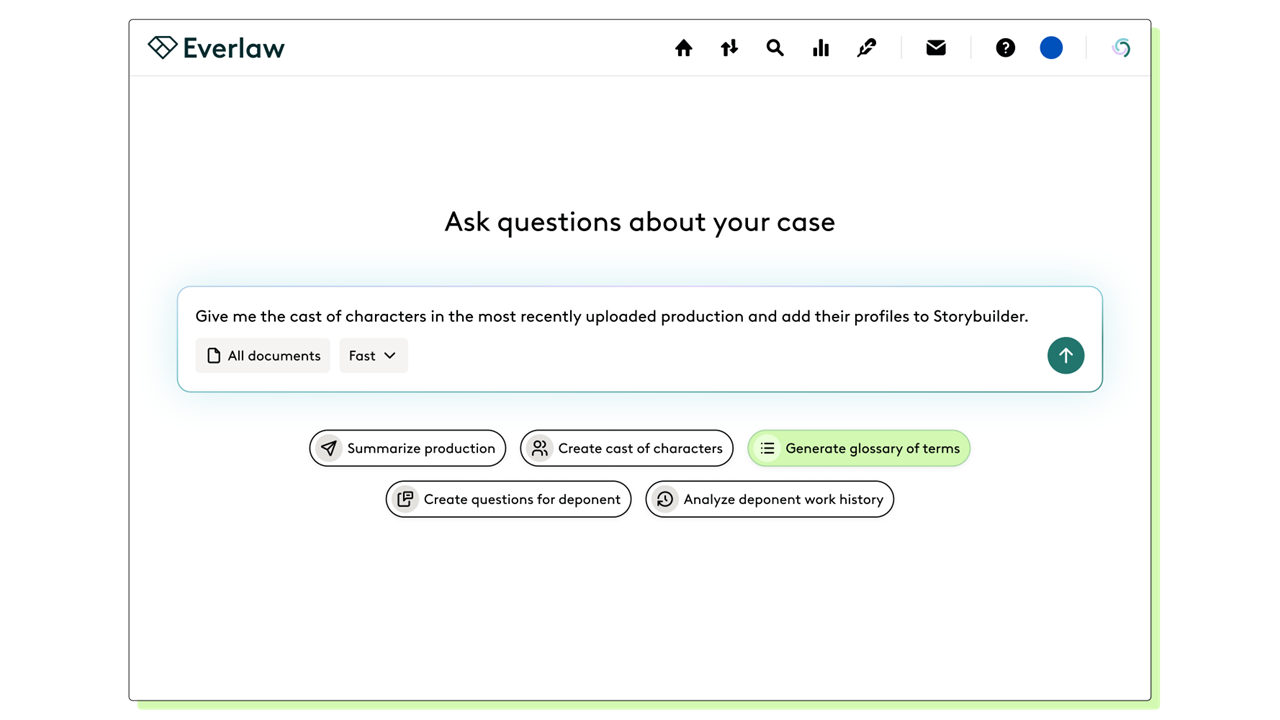


At its annual Everlaw Summit in San Francisco this week, the e-discovery company Everlaw unveiled Omni, an agentic AI investigation suite that orchestrates the full range of the company’s tools to answer questions about a case.
The company also launched Workflows, a drag-and-drop tool for automating complex document reviews, and Everlaw for Word, a Word add-in that links Bates citations back to source documents.
But when I spoke yesterday with Everlaw founder and CEO AJ Shankar, he said the news generating the most excitement among customers at the Summit was the company’s strategy of opening its platform to the general-purpose and legal AI tools its customers already use — Claude, ChatGPT, Copilot, Gemini, Harvey, Legora and others — through Model Context Protocol (MCP) connectors.
Shankar calls this strategy Everlaw Everywhere.
“Omni is great,” Shankar told me. “I think it’s going to be clearly the best agent tool in our field. But the very clear daylight between what we’re doing and what other folks in our field are doing on Everlaw Everywhere is probably the bigger news.”
Usage of Everlaw’s MCP is more than doubling every month, Shankar said, and that is before factoring in the Harvey and Legora connectors, that launch later this month.
Everlaw charges nothing to use the MCP connectors, neither to its users nor to the AI companies that integrate with it.
Although I was not at the Summit this year, Shankar met with me via Zoom for both an advance briefing on Oct. 15 and a follow-up conversation and demo yesterday, following his keynote on Wednesday.
An Agentic Everlaw Expert
Omni now subsumes Deep Dive, the AI question-answering tool that Everlaw made generally available after last year’s Summit. According to the company’s press release, customers have since added more than 300 million documents to Deep Dive and asked it nearly 100,000 questions.
“There’s no separate Deep Dive interface anymore,” Shankar said. “You ask Omni, and it chooses when to ask Deep Dive for you.” Customers with Deep Dive-enrolled databases will automatically transition to Omni as it rolls out.
Omni also has two other parts: a new Omni Agent, and Case Memory, a module that builds up knowledge of a matter over time.
Whereas Deep Dive retrieves relevant documents and synthesizes an answer to a single question, Shankar said that many questions require more than retrieval. They require cutting the data several ways — with communications analysis, document clustering, the data visualizer or structured search — the way expert Everlaw users do.
“Omni Agent is basically an expert at Everlaw, and it can use all of those tools on your behalf,” Shankar said. “Instead of you having to go jump from one to the other, you ask it a question.”
While Deep Dive can pluck answers out of the haystack, “sometimes your answers need to be sliced and diced out of the haystack,” he said.
In Everlaw’s internal evaluations against a known data set, Shankar said, the Omni Agent found about twice as many relevant facts as Deep Dive alone. “It turns out that everything else we’ve built over the last 10, 15 years is very useful,” Shankar said.
Getting A Demonstration
Shankar yesterday demonstrated the Omni Agent for me on the Mallinckrodt opioid litigation data set, a public collection of more than one million documents.
He started by asking, “Who are the main custodians?” That is a question Deep Dive cannot answer, he noted, because it requires counting across every document rather than sampling the relevant ones. Omni instead chose Everlaw’s entities tool and returned a table of the top custodians by document volume.
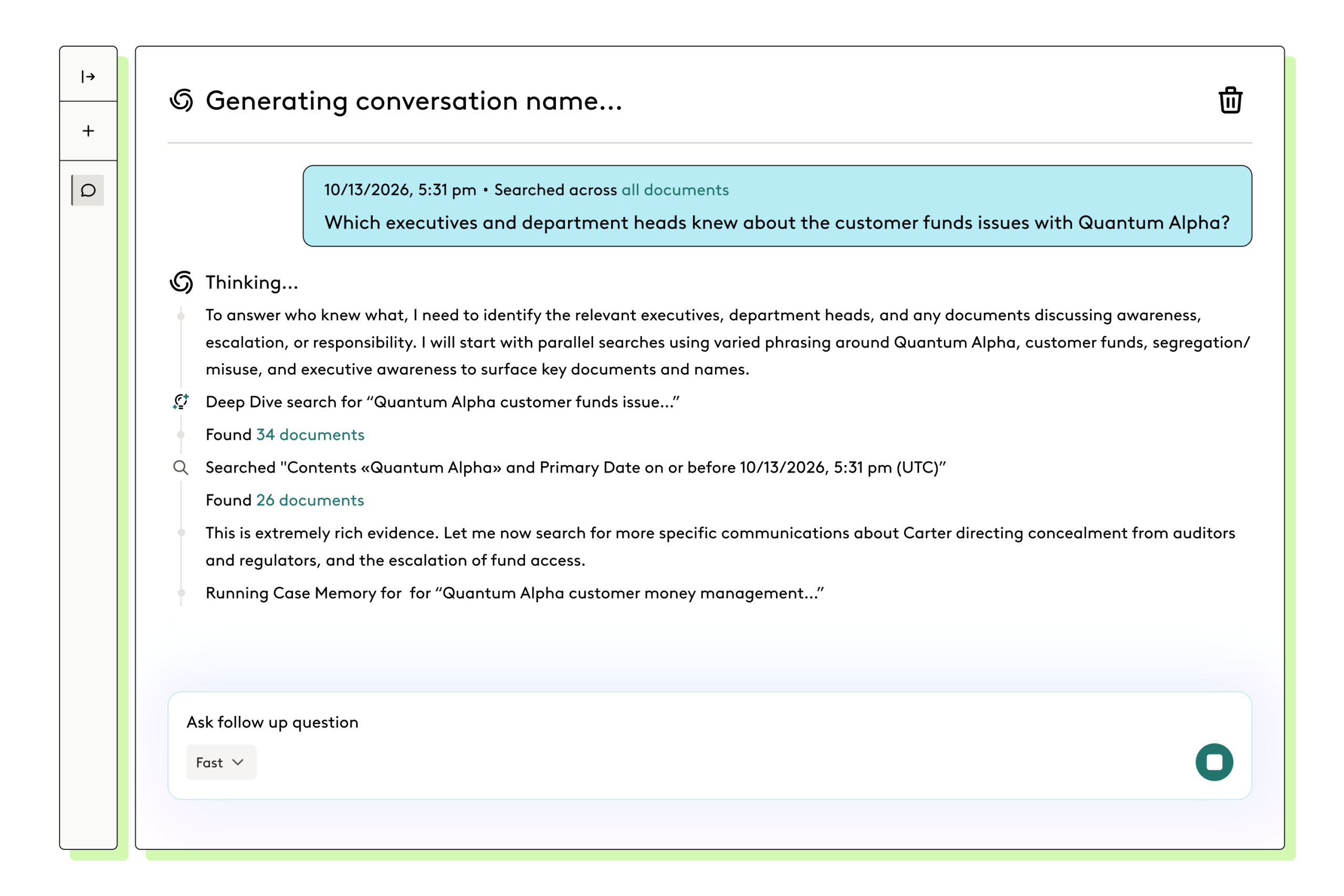
Next he asked Omni to find the documents in which one custodian, Karen Harper, communicated about suspicious orders, organized by subject and parties. For that, Omni drew on three tools — entities, search and Deep Dive — and produced a table of email threads, the people involved, and a summary of each, with numbered citations to the underlying documents.
His third prompt asked for a timeline of problems with Mallinckrodt’s handling of suspicious orders from 2008 through 2011. Omni’s visible “thinking” trace showed it first scoping a search to that date range and then sending off eight Deep Dive queries, each following leads from the last.
Finally, Shankar asked Omni to draft a deposition outline of Harper based on the findings so far. It produced objectives, key exhibits and questions, using only the evidence it had already gathered. It also added a caution that counsel should verify exhibit completeness, dates and privilege issues before use.
“In like 10 minutes, I’ve gone from, ‘Who are the custodians?’ to, ‘I’m going to depose Karen Harper, what should I ask?'” Shankar said.
Omni lets users expand its reasoning to see each tool it called and each Deep Dive query it ran. A sources panel lists every cited document. Omni conversations are visible to all users on the project with view permissions, although only the user who started a conversation can ask follow-up questions.
For now, Omni is able only to answer questions, but Shankar said it will soon be able to take actions within Everlaw as well, such as creating and managing search term reports, creating assignment groups, preparing a production, or doing work in Storybuilder.
Everlaw also plans to let users invoke the Omni Agent from within Claude, Harvey and other outside AI tools.
Case Memory
The third pillar of Omni, Case Memory, addresses what Shankar called an undervalued problem in litigation. Consider a contract reviewer who spends months on a matter and reads 10,000 documents. When that reviewer leaves, the codes and notes remain, but everything else the reviewer learned — the cast of characters, patterns of behavior, theories about why people did what they did — does not.
Case Memory is designed to capture all that. Users tell it what matters in terms of issues, people, events and concepts, or they simply upload the complaint. It then reads documents as review proceeds, pulls out relevant facts, and coalesces them over time.
It delivers that knowledge primarily through Storybuilder’s fact management tools, where it can suggest new facts, supply additional evidence for existing facts, or flag evidence that contradicts them. Every fact traces back to its source documents.
According to the press release, Case Memory’s facts will be available to Storybuilder and, eventually, to the Omni Agent.
Meanwhile, several Am Law 100 law firms are already using Omni through an early access program. Everlaw expects Omni to be generally available in early 2027 as a premium offering, with pricing to be announced.
Workflows and Everlaw for Word
The other major product launch, Workflows, is not an AI tool. Rather, it lets review managers map a complex review on a drag-and-drop canvas — routing documents by search criteria or properties, creating assignments, applying codes, sending subsets for QC sampling or translation, and moving documents into binders or Storybuilder.
Steps can be configured to be done by people or automated, and managers can insert gates that pause the process for human approval. Workflows can be templated and reused across matters, and managers can see at any point where documents are in the process and whether they are stuck.
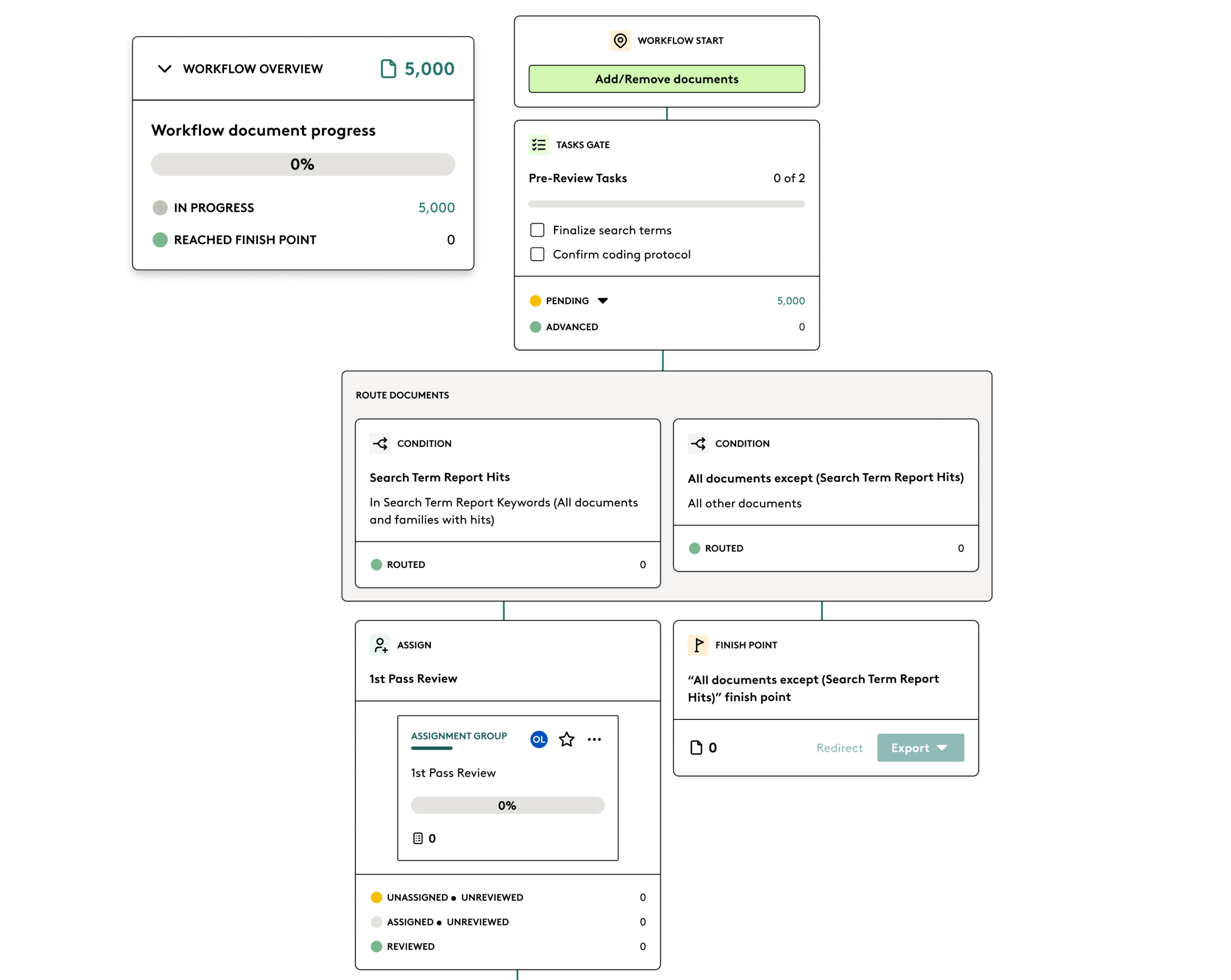
Most practitioners already run playbooks like these, Shankar told me, but they track them in spreadsheets or other manual ways. Workflows codifies them, which he said matters even more as outside AI tools begin driving Everlaw.
Eventually, he said, users will be able to initiate the workflow from within a tool such as Claude or Harvey, and it will run in Everlaw exactly as the user has configured it. “Then you don’t have to worry about whether the AI decided to do something different that day.”
Workflows will be available in November at no additional cost. Everlaw says additional AI review steps are planned for later releases.
Everlaw for Word, the Storybuilder Word add-in, automatically links Bates citations in a draft to the source documents in Everlaw. Future releases will bring Deep Dive into the add-in so users can search and add citations without leaving Word.
It is available now at no additional cost to organizations using Storybuilder, outside of GovCloud.
Everlaw Everywhere
The company’s Everlaw Everywhere strategy has been taking shape through a series of integration announcements this year. Everlaw’s Claude connector went live first, in May. In August, the company announced four more integrations and began describing itself as “the evidence layer” for legal AI.
| Partner | Announced | Status |
|---|---|---|
| ChatGPT Enterprise | Sept. 17, 2026 | Available |
| Microsoft 365 Copilot | Aug. 25, 2026 | Available since Sept. 2 |
| Harvey | Aug. 25, 2026 | Launching this month, per Shankar |
| Thomson Reuters CoCounsel Legal | Aug. 25, 2026 | Expected fall 2026 |
| Google Gemini Enterprise | Aug. 25, 2026 | Private preview as of August |
| Anthropic Claude | May 12, 2026 | Available |
| Legora | May 4, 2026 | Launching this month, per Shankar |
In a slide Shankar shared with me, Everlaw sits at the bottom as the evidence layer, with three ways to reach it: “in” users who work natively in Everlaw; “with” users who reach Everlaw as a service through AI partners; and “on” users who build custom applications through its API.
The idea, Shankar said, is that Everlaw remains the single system of record for the evidence and handles the discovery-specific work — defensibility, auditability and other discovery workflows — while customers use whatever AI tools they prefer for drafting and analysis.
He also said this can be a way to control AI costs. Rather than pour an entire case into a frontier model, an outside AI tool can use Everlaw’s search and Deep Dive to winnow the evidence first and pull back only what it needs.
MCP adoption among Everlaw customers has been rapid, Shankar said, with usage more than doubling every month. A chart he showed me tracking usage of only the Claude and ChatGPT connectors went from a few thousand in June to roughly 120,000 in September and an estimated 280,000 or so in October.
Weekly calls from Claude to Everlaw grew from about 2,000 in mid-June to about 45,000 in October.
Shankar said 80% of Everlaw’s customers have deployed a horizontal AI tool. And because those tools reach everyone in a firm, he said, “litigators who would maybe never normally log into a discovery tool are now using Everlaw in all kinds of creative ways through their AI agents.”
Guardrails — and Next Year’s Venue
Shankar emphasized that opening the platform does not mean “willy-nilly spraying your evidence out there.” Everlaw vets the security of its integration partners and ensures they do not keep copies of the documents, although they may keep the work product their tools create, he said.
Users’ Everlaw permissions follow them into the outside tools. “If you can’t do something in Everlaw, you can’t do the equivalent thing through Claude,” Shankar said. And Everlaw audits activity through the connectors. If a user runs Claude query that searches Everlaw, the audit log would record that user’s search through Claude.
Notably, Everlaw does not charge for any part of the connectors. “It’s free for the users and free for the integrators. No one pays us anything to do it,” Shankar said.
One final bit of news: Shankar told me that next year’s Everlaw Summit will move to Washington, D.C., to make it easier for the company’s East Coast customers to attend.