 Robert Ambrogi Blog


On Sept. 1, LexisNexis and EvenUp, an AI platform for personal injury lawyers, announced a forthcoming integration by which EvenUp’s customers could access legal insights and agentic AI in LexisNexis Protégé directly from within the EvenUp platform.
That integration is now live, and last week the two companies gave me a demo of how it works.
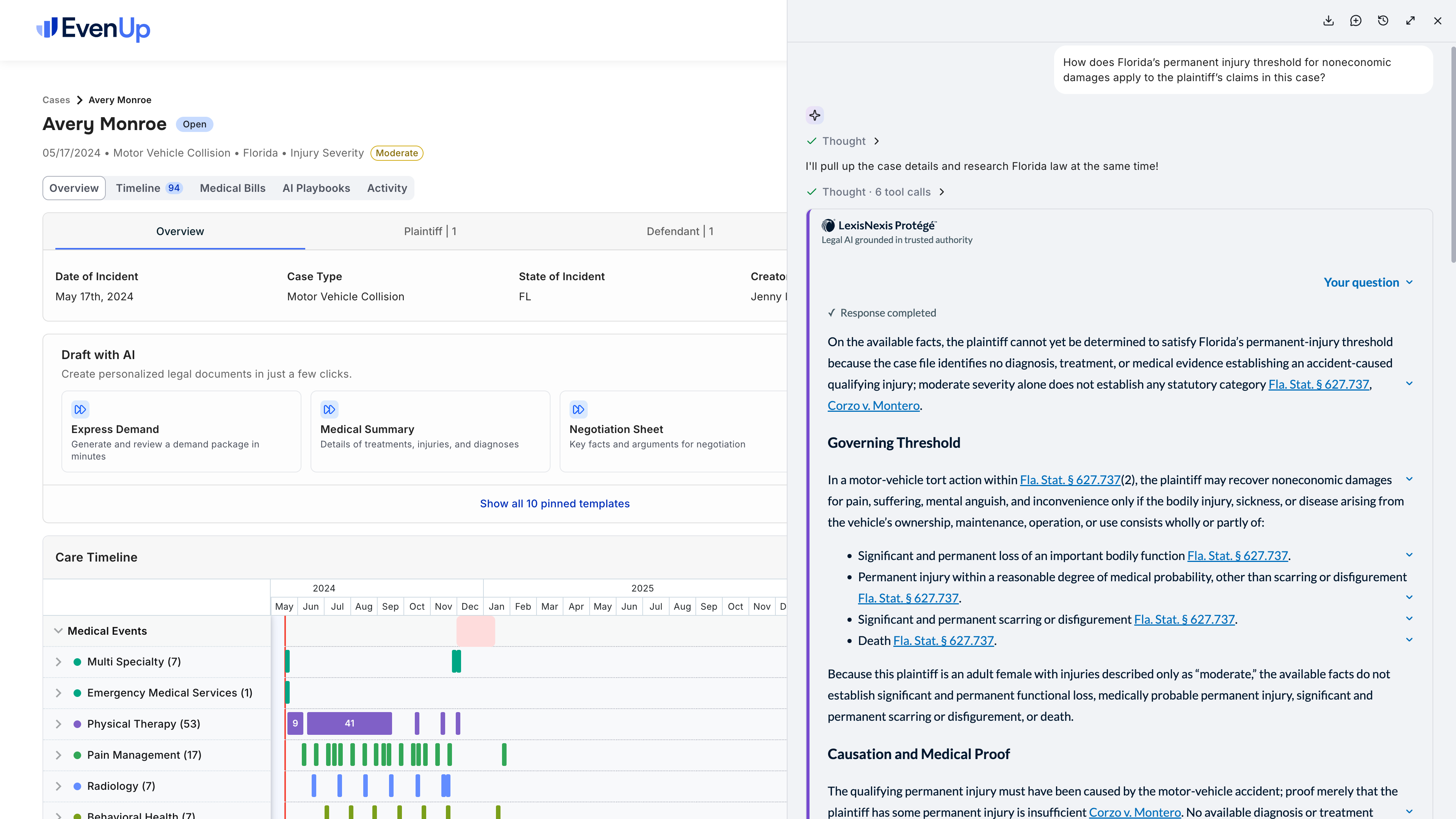
With the integration, EvenUp customers working in its Companion AI assistant can now directly invoke LexisNexis Protégé, ask a legal question, and get an answer grounded in Lexis case law and statutes, with the answer informed by the facts of the case drawn from the documents and other case materials already sitting in EvenUp.
From there, they can carry the conversation over into Lexis+ with Protégé to keep researching or drafting, with the full EvenUp context going along with it.
For now, however, the reverse direction – in which a lawyer working in Protégé pulls case facts out of EvenUp – is not available. That capability, the companies say, is coming.
Use of the integration requires subscriptions to both products.
An MCP Connection
When the companies announced what they called a strategic alliance in September, the press release said the capabilities were “expected to be available later this year.” They went live to customers earlier this month.
I was given a demo led by Saam Mashhad, cofounder and chief product officer of EvenUp, and Liz Christman, senior director of product management at LexisNexis.
The integration runs over the Model Context Protocol (MCP). EvenUp’s Companion treats Protégé as a standalone agent that a user can call from within a chat.
There is now a Protégé icon in the Companion prompt box. Click it and it initiates an MCP connection to Protégé, which then returns the answer.
Mashhad described what takes place between Companion and Protégé as “a dance.” Before the question goes to Lexis, Companion looks at the structured data EvenUp has extracted from the case file and the underlying documents, decides what facts are relevant to the question, and packages those facts along with the prompt.
In the demo, Mashhad used a sample case involving a Florida motor vehicle collision. He asked how Florida’s permanent injury threshold for noneconomic damages applied to the plaintiff’s claims.
Protégé’s answer described the four statutory thresholds under Florida law, cited several applicable cases, and then applied the standard to the plaintiff’s specific injuries as pulled from the EvenUp file.
“When you think about what somebody would have to enter to pull all of those targeted facts that are related to that prompt,” Christman said. “I know looking at our anonymized prompt data, we see prompts growing significantly in size. People are trying to share so much context about their case that you can see why they’re asking for these types of integrations that just do that seamlessly in the background.”
While Protégé already supports connections to a firm’s document management system, she said, that still requires the lawyer to figure out which files to upload. The EvenUp integration pulls out just the facts that matter.
Legal Questions and Answers
The Protégé response appears inside the Companion chat, clearly labeled as coming from Protégé. Each statement in the response includes a linked citation. Clicking a small arrow next to a citation expands the full supporting excerpt from the statute or case, so the lawyer can check the grounding without leaving EvenUp.
Below the answer is a list of the cited authorities, each with its Shepard’s signal. Clicking a case opens it in a new tab in Lexis+, where the full Shepard’s analysis is available.
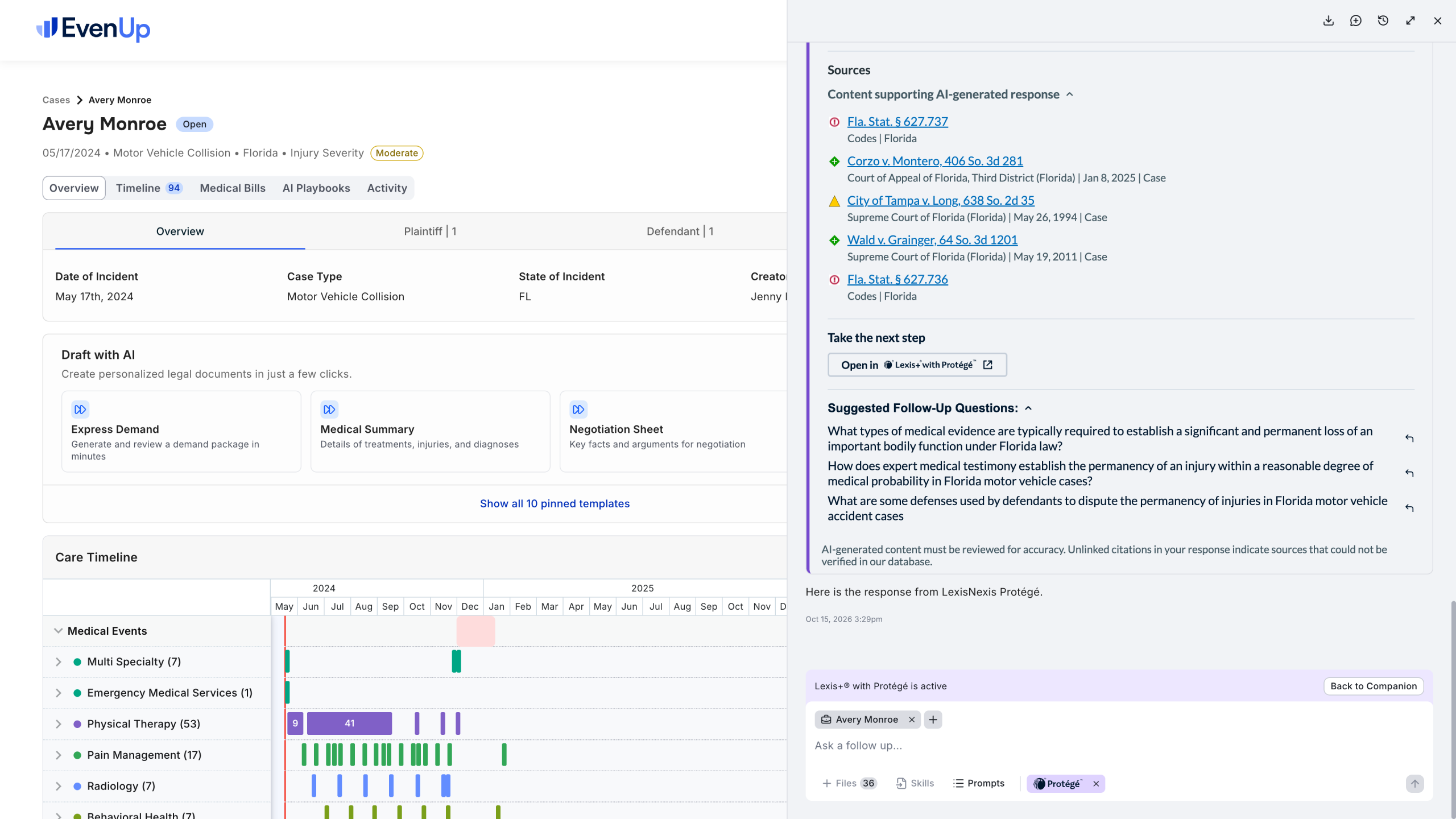
The response also offers suggested follow-up questions, which a user can run within EvenUp, and a button labeled “Take the next step” that opens the same conversation in Protégé.
When Christman clicked through to Protégé, the same answer appeared there, with its conversation history and the case context that came over from EvenUp. From there, she could type a new prompt, such as to draft a client memo, and Protégé would work from that context.
For now, the MCP integration is limited to legal questions and answers. “We haven’t incorporated drafting, for example, into the MCP application at this time,” Christman said. If a lawyer wants to use Protégé’s drafting tools, they do that in Lexis+, and the integration makes sure the context follows them.
Mashhad put it this way: “There’s a bunch of bespoke work that’s happening on both sides. It’ll be impossible to replicate all the capabilities and all the UI in both platforms.”
The goal, he said, is to combine facts and legal intelligence in one place and then let the user pick where to do the downstream work.
Still to Come
Still on the roadmap is the ability to start in Protégé and ask it to pull case information from EvenUp. “That’s something that we want to do near term,” Christman said. “You can’t do that yet in what’s live in production right now.”
The September press release described that second direction, in which Lexis+ with Protégé users could draw on EvenUp case intelligence, generate documents with agentic drafting, and save documents back to the EvenUp case.
Christman said the bidirectional connection “will be coming,” but beyond that, the companies are letting customer feedback drive the roadmap.
Access and Pricing
The integration is available to mutual customers of both companies. For EvenUp customers who do not subscribe to Protégé, EvenUp is offering a 30-day free trial with a limited number of conversations, accessible by clicking the Protégé icon in Companion and signing up.
I asked whether mutual customers get any special pricing. Christman said she is “not the pricing person” but that both companies have promotional offers in their toolkits and are “incented to win over those customers who may not be using Protégé right now.”
Mashhad said it is “much more financially beneficial for any law firm to work with both EvenUp and LexisNexis combined than with us individually,” but neither offered specifics.
One other point worth noting: REV, the venture arm of RELX, which owns LexisNexis, is an investor in EvenUp.
The Bigger Picture
During our demo, Mashhad offered what he described as a meta comment – that the legal tech industry is converging on a model in which vendors specialize and then interconnect.
EvenUp, he said, focuses on workflows and “getting the facts right” across the life of a personal injury case, from intake through settlement. “But there are big pieces of this that are missing. The biggest piece is legal intelligence.”
From the LexisNexis side, Christman said, the integration is consistent with a strategy of “bringing our powerful legal intelligence into whatever environment our attorneys or customers are working in.”
As MCP connectors quickly become ubiquitous in legal, this integration offers a concrete example of its practicality, combining a practice-specific platform that houses the facts and a research platform that supplies the law, with a seamless connection for the lawyer who needs to bring those two facets together.